

I used to have a terrible roommate. I’ll not go into much detail on why this roommate was terrible beyond mentioning that they stole all of my forks and threatened self injury. Frankly, to be fair to them, I was not a great roommate either. I am a neat freak, I am confrontational, and I had my partner over often. By often, I mean enough that I had to scroll r/badroommates with a considerable amount of cognitive dissonance, as the netizens there despise anyone in their homes that isn’t on the lease. Just because someone is worse, that doesn’t mean you don’t also have faults. However, one thing I believe I unfairly begrudged my ex-roomie for was their obsession with a specific show. Every conversation would circle back to the show. At the time it was maddening, but in retrospect I wonder how much of that was just resentment at the idea of someone indulging in a social faux pas that I had trained myself not to commit.
Special interests fall under the symptom class of restricted and repetitive behaviours in Autism Spectrum Disorder as per the DSM V. Defined as “Highly restricted, fixated interests that are abnormal in intensity or focus”(1). Due to online proliferation, this term has faced similar dilution in meaning that other clinical related words have. “Gaslighting” morphed from a description of psychological manipulation, where an abuser warps their victim’s grasp on reality, into simple lying. “Hyperfixation” from describing a state of intense, prolonged focus to the point of neglecting one's physical needs, to a word used to describe a general enthusiasm for a subject. “Nonverbal” describes an individual who cannot speak, but has been adopted by those perfectly capable of speech. Using the phrase “I’m going nonverbal” to poke fun at their choice to stop talking. This shift in how language is used is not a new phenomenon, it is one that is well documented in the study of linguistics. “[All] languages constantly create expressive usages of words or phrases that gradually wear”(2). The unfortunate result of this shift is that language must then compensate for the gap in understanding left behind by the loss of meaning. The terminology must be replaced and escalated to maintain understanding. Similar to superhero movies, where each sequel must have a bigger, badder villain in order to maintain the level of excitement and tension that the audience felt watching the original. In the first movie our hero is fighting a villain taking over the city, by our 2nd, an alien invasion, by our 3rd, a god. We cannot halt the decay of meaning, we can only protest the preemptive murder of it.
Autistic special interests, regardless of the terminology we use to describe them, differ from the interests of non autistic folks, including those with hyperfixations that are similarly disabling but distinct. Notice the descriptive language in the prior DSM V quote, “Highly restricted, fixated interests that are abnormal in intensity or focus”(1). While this language is pathologizing in nature, it is accurate. Autistic individuals' special interests are all consuming, they are “more specific, more numerous, and more frequently in systemizing domains than the interests of [typically developing] individuals”(4). My experience of living with Autism reflects this as well. I have had some interests enduring and time consuming enough to consider special interests, and my experience of them differed from my experience of other interests. To illustrate the difference between these, hyperfixations, and normal hobbies, here are some real life examples.
I love to swim. When I go swimming I feel satisfied and it relieves my stress. I want to go swimming more often but it only really pops briefly into my head in the warm months or when I need a pick-me-up.
Every few months I dust off my sewing machine that I taught myself to use. I will spend 8-12 hours completely engrossed in a new project, during which I will often forget to eat, drink, or use the bathroom. I get so absorbed into this flow state that it feels painful to pull myself away. I will go on research spirals learning everything I possibly can on french seams or the best way to sew a zipper on. When my focus finally breaks I am hit all at once by the bodily cues I have been ignoring and I feel awful. If this focus break happens in the middle of the project then it is likely the project will remain unfinished for months, years, or often permanently. Later I will walk by the unfinished project and feel guilt for not having the motivation to finish it.
I loved to play the Sims 2 on my Playstation 2 as a kid, so when I heard that The Sims 3 was set to release on PC in the summer of 2009 I became insatiable in my anticipation. I had a friend who was similarly excited so I talked her ear off about it day after day. Away from her I found myself dominating conversations with people who quickly grew tired of my obsession. I struggled to pay attention in class as the graph paper we used for math class was the perfect medium to plan my future Sims houses on. Building in The Sims 3 is done on a grid and I knew the exact amount of spaces each object took up on that grid (I still do, a double bed is 2x3). This allowed me to map out houses on paper during class, then take them home and spend many hours on my mother’s PC building them. I dreamed about playing the game, I watched youtube videos of other people playing it (shout out to Curtis Paradis), I wrote an essay to my parents on why they should buy me the Supernatural expansion pack, I knew all of the lore, and pretending I was a Sim helped me cope with daily living. The Sims occupied my thoughts to an incredible degree. This intensity of this interest stayed steady for years, until The Sims 4 released and I began to play that, which was simply not as fun as the second or third installment.
Given the three examples above, which would you say is a special interest?
If you guessed that swimming is an interest, sewing was a hyperfixation, and The Sims 3 was a Special interest then you would be correct. To be clear, Allistic (non-Autistic) people are perfectly capable of having interests that could be described as special interests in their degree of passion. If you have ever met a marathon runner, football fan, or astrology enthusiast, then you know this already. However, Autistic special interests differ in their specificity, longevity, and intensity of impact on an Autistic person's daily life(6), as well as how common they are. While 90% of Autistic individuals have special interests, only 30% of Allistics do(5). Autistic special interests also often last years compared to roughly 22 months for Allistics(5). These interests are more niche in popularity(5), and tend to be in systemizing domains, which is fancy speak for topics with predictable patterns or rules. Think city planning, bird facts, psychology, coding, or the Autism classic, trains. The impact of these intense interests can be positive, providing stress relief, but it can also be negative, causing interpersonal friction, frustration, financial strain, and neglect of other areas of life. Bluntly speaking, while an Allistic person may very well be annoying about their interest, they are not generally disabled by it.
The social friction caused by my preoccupation with my special interest is something I am still struggling with to this day. Like many Autistic children, diagnosed or undiagnosed, I internalized the negative reactions I received(7). As I grew into an adult I stifled my natural urge to share my enthusiasm in an attempt to be more palatable. It still slipped out of me more often than not but I berated myself for these violations. At home I consistently prioritized responsibilities over joy. Seeing indulging in my special interest as a reward for getting the menial tasks of life done. Life though, is a never ending cycle of working, cooking, doing laundry, dishes, and emailing people back. This meant that I was burning myself out on chores while neglecting when I really wanted to do. While special interests can cause harm by way of us neglecting our needs, we can also cause ourselves harm by neglecting our special interests.
As with most of life, the key is balance.
Burdened with what has been theorized as a hyperconnected, overactive mind(8), special interests can be a vital tool for an Autistic person to ground and relax themselves. Providing an outlet for the high levels of distress that come with living with this condition. While it is different for everyone, the worst distress I experience is layered. In my assessment I described to the specialist that it is not the volume of a sound alone that causes me sensory overwhelm. Rather it is the complexity of many layered sounds, sensations, sights, scents, and emotions. I am perfectly capable of driving with my music blasting, but put me in a supermarket with gently humming fluorescent lights, people talking, carts squeaking, and registers beeping? That has sent me over the edge into an embarrassing public meltdown more times than I would care to admit. This complexity feels like I am a laptop melting under the weight of hundreds of open chrome tabs. The processing power of my brain no match for layered sensory inputs. Inputs that I cannot tune out as an Allistic person would.
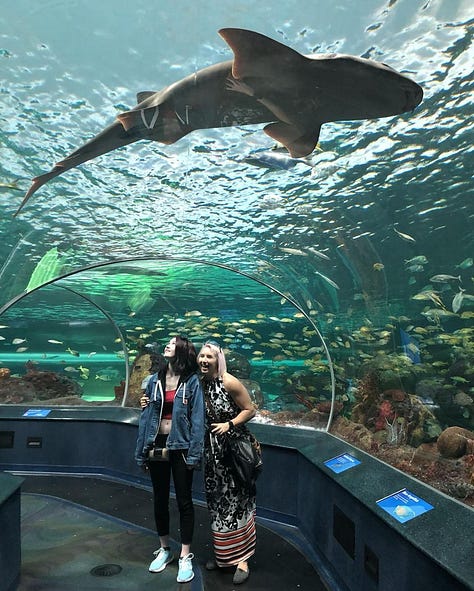
In contrast, indulging my special interests comes with a unique quiet that I do not experience elsewhere. My mind stills, chrome tabs close. The world around me shrinks. Imagine you are in a well lit house, what can you see? The pile of dirty dishes in the sink? The stack of official looking mail that fills you with dread? The torn window screen demanding your attention before the weather warms up? Now turn off all the lights and light a candle. Your perceivable world has shrunk in size to only your immediate surroundings. This is how The Sims felt to me as a kid, and it is how learning about sharks feels to me now. It is difficult to properly rest with lights beaming down on your face. This quiet dark space is one I wake up from feeling rejuvenated, like a wonderful night's sleep. A peaceful state, so unlike my experience of the rest of the world, that it is unsurprising that some people become stuck in it.
In a study of Autistic adults, researchers found that too much engagement with their special interests was correlated with a decrease in wellbeing. Suggesting that “while special interests may have a positive impact on autistic adults, [...] there may be a trade off”(9). The researchers concede that this correlation may be inverse, that feeling badly may instead motivate a higher engagement with special interests. This I believe to be true, however I do not believe it invalidates the possibility of special interests causing a negative effect as well.
Again, finding balance is important. Here are some scenarios that could be considered unbalanced,
Samuel spends hundreds of dollars on a high end telescope. He adores it, becoming completely absorbed. Only to realize a few days later that he doesn’t have enough money for groceries and missed his friend's birthday.
Jazmine has low support needs, she works part time but when she comes home she collapses into bed to scroll tiktok for the rest of the evening. She tells herself she has no time to take care of a fish tank even though she has always wanted angelfish.
Samuel and Jazmin exist on opposite ends of the engagement spectrum. Samuel is engaged with his interest in astronomy to the detriment of his financial and social health. Jazmine is denying herself this engagement to the point that it may be exacerbating her overwhelm. While there is no significant difference in wellbeing for Autistic individuals who do not have a special interest, those of us that do have them hold a powerful tool. One capable of both damage and restoration.
Balance though is an ambiguous concept. How do we find it? Well the hardest part is knowing when our engagement is unbalanced, so if you can do that, you have done most of the work already. Autistics can have poor interoception skills and alexithymia. This means we may struggle to accurately recognize and interpret physical and emotional sensations. Personally, my emotional range at any given moment is “I feel good” or “I feel uncomfortable”. It is only in retrospect that I can break down the causes of sensations and then label them. “I’m uncomfortable” could be anything from a full bladder to grieving a loved one, but I cannot distinguish those while the discomfort is actively occurring. This adds a layer of complexity to recognizing unbalance.
As a quick, but not exhaustive point of reference, here are some common signs: Financial strain, neglecting physical needs (hunger, sleep, hydration, hygiene), blowing off prior commitments, conflict in your relationships, feeling empty or depressed, increased sensitivity to overwhelm, a decrease in energy, or increased anxiety. If you notice any prolonged symptoms and you have been either more or less engaged with your special interest, it is worth considering whether you are over indulging, or failing to nurture your passions.
From this awareness we can identify the areas our engagement is damaging our wellbeing, and create strategies to address them. We can return to Samuel and Jazmine for an example of how their situations could be improved.
For Samuel we know the areas of damage are his relationship with his friend whose birthday he missed and his bank account. The answer is not a blanket “do not buy the telescope”. While that may be the logical conclusion for an allistic person, Samuel finds an immense amount of stress relief in his love of astronomy, and as we have discussed, special interests are a valuable tool to managing Autistic overwhelm. Rather than abstain all together, Samuel should make sure the telescope he wants is within his budget. This could look like sitting down with someone on his care team to write down all of his expenses between now and his next disability cheque. Then subtracting those expenses from his current balance to see if the difference is enough for the telescope. If it is not, then he could consider other avenues. Can he set aside some money to save up? Would his loved ones be interested in splitting the cost with him as a birthday present? Are there any budget telescopes that may not be as high quality, but could serve as a satisfying stopgap? Does his library or local community have any astronomy related groups? The disabling nature of Autism means we may not always have the material resources to achieve our desires, but if we think outside of the box we can often find a way to stoke the flames of our passions without burning up our wallets.
Samuel’s other area of struggle is his friendship. A popular talking point on TikTok has been ascribing high empathy to Autism in an attempt to shake free of stereotypes(10). However, this unfortunately can cause collateral damage to our Autistic siblings who do experience low empathy or theory of mind. Reinforcing low empathy as a moral failing rather than acknowledging it as a disability related difference. Which is ironically pretty unempathetic for the self proclaimed empaths. Trouble empathizing may cause an Autistic individual to upset others unintentionally as they struggle to understand or grasp the existence of a different perspective. Maybe Samuel doesn’t care about his own birthdays so it didn’t strike him as important when his friend mentioned that their birthday was approaching. That does not mean he doesn’t value his friend, just that there was an unspoken expectation he missed. To lessen the interpersonal friction of prioritizing our special interests over our loved ones we may need extra clarification, reminders, and clear setting of expectations.
Jazmine on the other hand, has the problem of under engagement with her special interest in Aquariums. She may feel as though her life lacks meaning because all she does is work, rot in bed, and work again. She cites a lack of time and energy as a reason for her excessive scrolling, however Autistic individuals with special interests experience a blow to their wellbeing during periods of low engagement. Rather than getting too wrapped up in the chicken or the egg evaluation of which came first, burn out or low motivation, Jazmine should try to integrate some low effort engagement to start. Maybe instead of scrolling her FYP she could specifically seek out aquascaping TikToks. She could also research Angelfish, watch youtube videos on cycling tanks, and do some rough sketches of how she would lay out her dream Aquarium. From there she can begin to ramp up the engagement, playing Aquarium Simulator on her laptop and stopping by the local fish store after work to look around. While engagement with her special interest will not cure her of the burden of work, it may improve her ability to cope with it. Jazmine should be proud of herself, as she is one of the only 33% of employed Autistic Canadians(11). This achievement though does not indicate a lack of struggle, so she should be especially cognizant of her needs in order to ensure she is as supported in this struggle as possible. When she is ready, she may find that having a fish tank is something that helps get her up in the morning rather than being yet another energy drain.
It is undeniable that the world we live in is not built with Autistic individuals in mind and support is sparse. An exploratory study of Autistic individual’s needs found that “70% of participants don’t have sufficient access to mental health services”, “40% of participants lack any short-term savings”, and “a third of participants report [...] living situations that don’t fully meet their needs.”(11). Many of us rely on loved ones to bridge this support gap. Many of us have no one but ourselves. In either scenario we must be proactive and creative in structuring our lives to be as compatible with our Autism as possible. The restructuring of society to accommodate neurodevelopmental differences is a wonderful goal for the future, and harm reduction can make the present more bearable in the meantime. I hope that reading this has shown you what a valuable tool in your harm reduction toolbox special interests are. Through a compassionate understanding of the functions of Autistic special interests we can give ourselves the permission to experience joy, and the boundaries to maintain moderation.
We can live a more balanced life that honours our differences and reflects who we truly are.
Thank you for reading! The Worth of Me is supported by people like you. You can become a free subscriber to receive new posts. Paid subscribers also have access to the archive of my past work, behind the scenes musings, and giveaways.
Works Cited
1: American Psychiatric Association. Diagnostic and statistical manual of mental disorders. 5th ed. Arlington, VA: American Psychiatric Association; 2013.
2: McWhorter, John. The Power of Babel: A Natural History of Language. Cornerstone Digital, 2011.
3: Nowell, Kerri P et al. “Characterization of Special Interests in Autism Spectrum Disorder: A Brief Review and Pilot Study Using the Special Interests Survey.” Journal of autism and developmental disorders vol. 51,8 (2021): 2711-2724. doi:10.1007/s10803-020-04743-6
4: Jordan, Chloe Jennifer, and Catherine Caldwell-Harris. "Understanding Differences in Neurotypical and Autism Spectrum Special Interests through Internet Forums." Intellectual and Developmental Disabilities 50.5 (2012): 391-402. ProQuest. 5 May 2025
5: DeLoache, J. S., Simcock, G., & Macari, S. (2007). Planes, trains, automobiles-and tea sets: Extremely intense interests in very young children. Developmental Psychology, 43, 1579-1586.
6: Anthony, Laura Gutermuth et al. “Interests in high-functioning autism are more intense, interfering, and idiosyncratic than those in neurotypical development.” Development and psychopathology vol. 25,3 (2013): 643-52. doi:10.1017/S0954579413000072
7: Winter-Messiers, M. (2007). From tarantulas to toilet brushes: Understanding the special interest areas of children and youth with Asperger's syndrome. Remedial and Special Education, 28, 140-152.
8: Supekar, Kaustubh et al. “Brain hyperconnectivity in children with autism and its links to social deficits.” Cell reports vol. 5,3 (2013): 738-47. doi:10.1016/j.celrep.2013.10.001
9: Grove, R., Hoekstra, R. A., Wierda, M., & Begeer, S. (2018). Special interests and subjective wellbeing in autistic adults. Autism research, 11(5), 766–775. United States: Wiley Subscription Services, Inc.
10: Images sourced from TikTok under the search term “empathy autism”, only videos with several thousand or more views have been included as examples of how anecdotal experience going viral can contribute to online misinformation.
11: Rosen, Brittany. “Canadians Living with Autism Overlooked for Employment Opportunities: Report - Toronto.” Canadians Living with Autism Overlooked for Employment Opportunities: Report, Global News, 31 Mar. 2022.
12: Mackenzie Salt, Marina Schor, Simone Daniels, Jonathan Lai, Stelios Georgiades, Deepa Singal. Fostering Inclusion: Exploring the Needs of Autistic Adults in Canada. An Autistic-led Survey. Autism Alliance of Canada. April 2024